
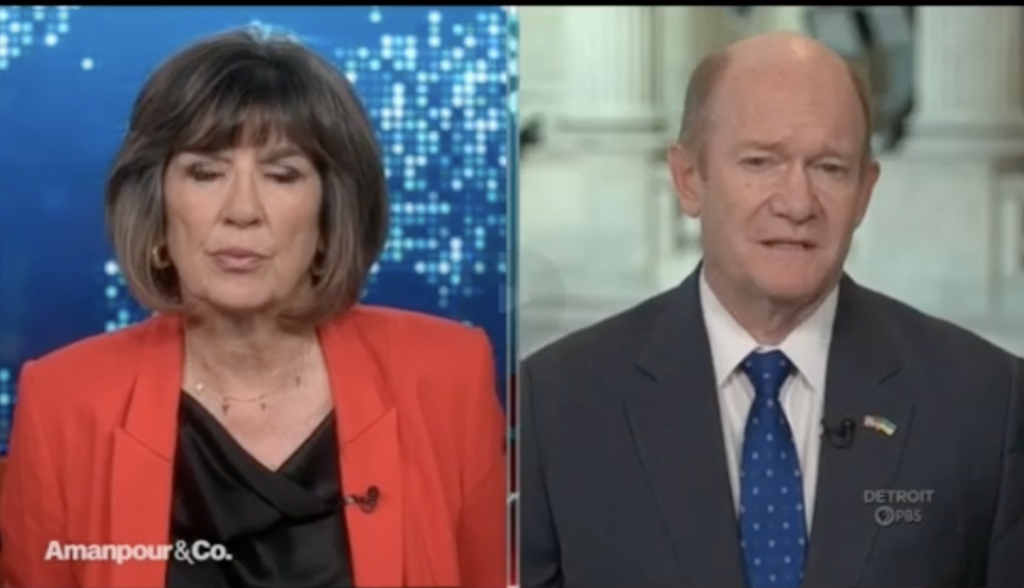
Christiane Amanpour opened the October 1 episode of PBS’s *Amanpour & Company* from London. Yes, London—a host delivering news and commentary to an American public television audience from overseas.
She discussed Russia’s attacks on Ukraine. But where was the discussion of Ukraine’s recent attacks inside Russia, particularly its strikes on the Moscow oil refinery on September 20 and the Novoshakhtinsk oil refinery on September 25? Disrupting Russia’s fuel production is part of Ukraine’s war strategy. The consequences for fuel markets and diesel prices right before the midterm elections also deserve attention.
Then, about four minutes into the program, Amanpour introduced her first guest. And you guessed it: a Democrat. Her guest was Chris Coons, the Democratic U.S. senator from Delaware, first elected in 2010. Coons accused President Trump of encouraging Xi Jinping in the same way that he is encouraging Vladimir Putin’s aggression against Ukraine:
Xi Jinping continues to make clear in every possible setting that reunification with Taiwan by force if necessary is his principal goal. And by failing to be clearer and stronger about our views on Taiwan and on our competition with China, I think Trump is encouraging Xi in the same way that he’s encouraging Putin and his aggression against Ukraine and his adventurism in testing NATO, by being insufficiently clear and tough.
Coons calls it encouragement? Let’s look at what Trump has actually done.
On October 22, 2025, Trump’s Treasury Department sanctioned Rosneft and Lukoil, Russia’s two largest oil companies, along with numerous subsidiaries. Secretary Scott Bessent said:
“Given President Putin’s refusal to end this senseless war, Treasury is sanctioning Russia’s two largest oil companies that fund the Kremlin’s war machine.”
How does targeting Putin’s war funding amount to encouraging his aggression? Then, on September 18, 2026, Trump signed bipartisan legislation expanding Russia sanctions and tariff powers. That includes tariffs of up to 100 percent on imports from qualifying countries buying Russian crude oil or natural gas, or facilitating sanctions evasion. Trump signed legislation designed to increase economic pressure on Russia and those helping sustain its energy revenues.
Trump has also told Putin to stop, in public. After Russian strikes on Kyiv in April 2025, he wrote on Truth Social:
“I am not happy with the Russian strikes on KYIV. Not necessary, and very bad timing. Vladimir, STOP! … Lets get the Peace Deal DONE!”
He later said he told Putin on a call that it was time to stop the war. In October 2025, after a Russian missile test, he said Putin ought to end the war instead of testing missiles. That is not the language of someone rolling out a red carpet for continued aggression.
American weapons support for Ukraine has continued, too. Through NATO’s Prioritized Ukraine Requirements List, allies and partners purchase U.S. military equipment for Ukraine. Ukraine’s government reported cumulative contributions of about $6.7 billion by late July 2026, with deliveries underway. Having allies pay for those weapons changes who foots the bill. It does not erase the military support reaching Ukraine.
Coons went further, treating the Anchorage summit and the chip decision as evidence that Trump has taken both sides and refused Ukraine the support he thinks it deserves:
When Trump came into power again for his second term, there were in place export controls on advanced AI chips that were very bothersome to China. He’s now moved to allow Nvidia chips to be exported to China. He’s not standing up for America’s best interests in constraining China’s advance in AI. In the same way, he rolled out the red carpet for Putin in Anchorage and has taken both sides of this war, encouraging Zelensky to make concessions, to give up territory, and refusing to provide the sort of tough sanctions and ongoing military support that I think Ukraine deserves. So, President Trump, by the way, he’s been acting with regards to both of these aggressive authoritarians, Putin and Xi is encouraging aggression.
The Anchorage meeting on August 15, 2025 produced no peace agreement. But Trump’s actions did not end with that meeting. The October 2025 oil-company sanctions and the September 2026 law challenge Coons’s claim that Trump is refusing tough sanctions.
On Taiwan, Trump’s administration approved an $11.1 billion arms package in December 2025—the largest ever. A separate proposed $14 billion package remains stalled. On September 29, Taiwan’s own defense minister said existing arms sales and cooperation remained unchanged and that Washington had provided assurances that its policy had not changed.
Coons points to Nvidia chip exports as evidence that Trump is encouraging Xi. But in January 2026, the Commerce Department allowed case-by-case review of H200 and comparable chip exports, with customer screening and independent testing. That is conditional access with safeguards. Coons still has to explain how that policy amounts to encouraging an invasion of Taiwan. The latest Blackwell chips were not cleared.
Coons can dislike Trump’s diplomacy, his negotiating tactics, and his decisions on technology exports. But viewers still deserve the record he skipped: sanctions on Russia’s largest oil companies, expanded sanctions legislation, continued access to American weapons for Ukraine, public demands that Putin stop the war, and a record arms package for Taiwan.
Calling Trump insufficiently tough is Coons’s opinion. Claiming he is encouraging aggression requires more than pointing to the decisions Coons dislikes while leaving out the actions that challenge his accusation.
Watch on Rumble