
On March 13, 2026, Ali Velshi filled in for Lawrence O’Donnell, and from the start it was clear this was not objective reporting. It was political advocacy dressed up as news. He opened by trashing Pete Hegseth, then brought on a former Democratic ambassador to Russia to reinforce that framing. He read from the New York Times, attacked Trump, used Judge Boasberg’s words as if they were neutral proof, and brought on a Democrat from Virginia on the Armed Services Committee to push the same narrative on Iran—that Trump was using the war with Iran to cover for the Epstein files. Next, he featured Democrat Robert Reich, who argued that the public can only focus on one or two stories at a time, “and nowhere beyond that,” portraying Americans as too dumb to follow more than two major stories at once. All of this came before he started talking about DOGE and Musk.
The pattern was unmistakable: this was not about informing viewers, but about advancing Democrat propaganda.
Velshi claimed Trump and Musk failed. He portrayed DOGE as uninformed and careless, arguing that it was cutting DEI programs it did not even understand while presenting those programs as clearly having positive effects on people’s lives.
Velshi declared:
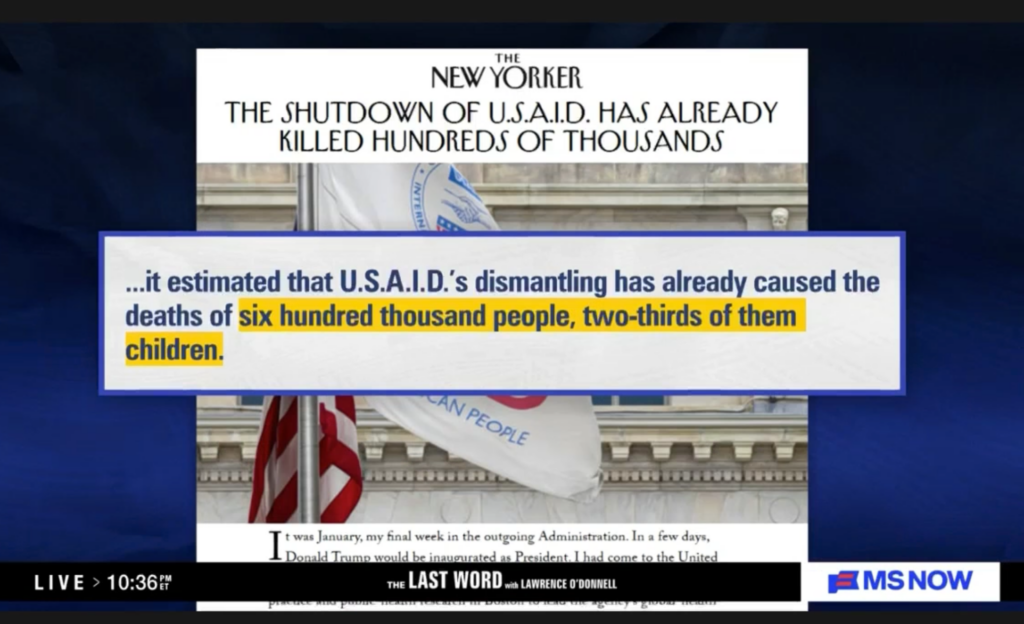
We know what the DOGE chainsaw did. It waged war on federal workers and their livelihoods, it attacked America’s science and health research, and worst of all, dismantled life saving USAID grants, which is estimated to have caused the deaths of approximately 600,000 people, two thirds of whom are children. That number of deaths will continue to rise.”
Velshi made a massive accusation without presenting any proof. The 600,000 figure is not a confirmed death toll but a projection model built on liberal assumptions. He did not show one verified death caused by DOGE cuts, yet he presented the estimate as fact. That is not journalism. It is political framing built around the most emotionally powerful number available.
Velshi was just as selective in how he framed Musk’s podcast comments. He highlighted Musk saying he probably would not do it again, but left out the fuller reason Musk gave: that he would have stayed focused on his companies and “they wouldn’t have been burning the cars,” referring to the backlash and vandalism tied to his role. That is not the same as admitting DOGE was wrong or failed. It is an acknowledgment of the personal and business cost of taking on a political fight this big—challenging wasteful programs, balancing budgets, and bringing accountability to the U.S. government and its $39 trillion debt.
Protests against DOGE, portrayed by Velshi as broad “resistance” and “voter anger,” were largely organized by Democratic-aligned groups and activists—not reflective of most Americans.
He offered no balance. Rather than test the claim or examine competing evidence, he surrounded it with Democratic voices and pushed one narrative.
What Velshi delivered was not journalism but Democrat propaganda: a one-sided case against DOGE, built around partisan voices and a death claim he never proved.
After this clip he brought on another Democrat Congressman who was on the House oversight DOGE committee. Then after that Velshi brought on the President & CEO of Democracy Forward which has sued to stop DOGE more than any other organization.
After that, Velshi argued Democrats would win Congress in November. Then brought on a Democrat running for the Senate to promote his campaign.
It fit the pattern of the entire show: one Democrat after another, all reinforcing the same political narrative against Iran, Trump, Republicans, Musk, and DOGE.
What Velshi delivered was not journalism but Democrat propaganda.
MSNBC really should have changed its name to MS DNC.
Watch on Rumble