
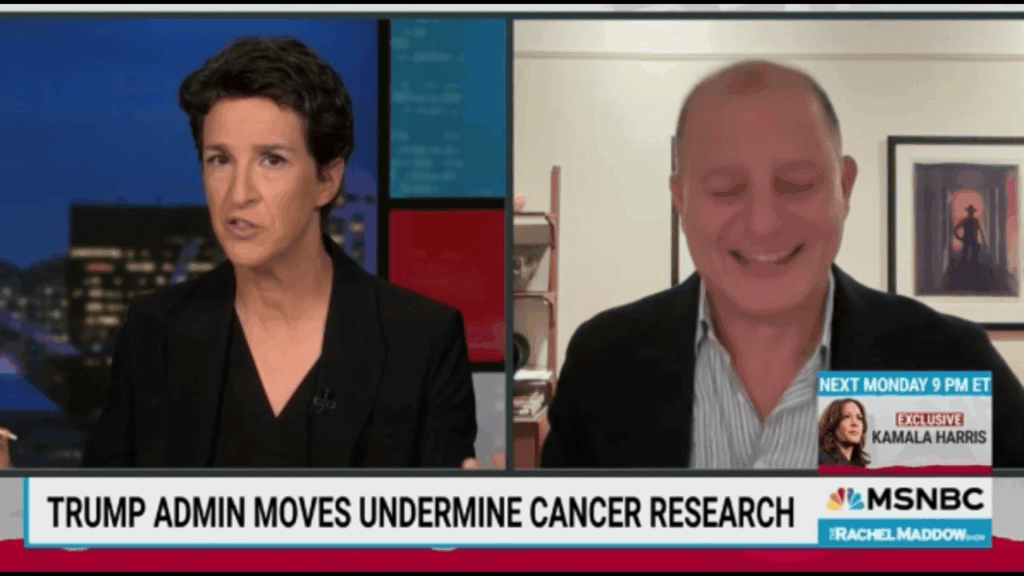
On MSNBC, Rachel Maddow framed her segment with Jonathan Mahler of the New York Times Magazine under the headline: “Trump Admin Moves Undermine Cancer Research.” Mahler echoed that message, claiming the administration is carrying out a deliberate, conscious effort to dismantle the biomedical research system, to dismantle the cancer research system.
Maddow, meanwhile, went for the smear:
“And, and I mean, forgive me for asking it this way, but is there some earth 2 out there? Is there some corner of the MAGA world or the conservative political universe that I’ve never stumbled upon where cancer is good and cancer research is bad, where there’s some conspiratorial mindset around cancer research, something akin to the way they’ve demonized the public health miracle that is vaccines.”
Instead of responding with seriousness, Mahler cracked up. Think about that — on a subject as heavy as cancer research, his reaction was laughter. It shows the tone of the whole segment: sneering, mocking, and making conservatives the punchline rather than offering sober analysis. For Maddow and Mahler, it wasn’t about science or saving lives. It was about scoring political points on national television.
Mahler then piled on with more alarmist rhetoric:
“This isn’t, this isn’t an effort to reform cancer research. This is an effort to dismantle and defund cancer research. There’s no plan, there’s no, well, we’re doing all this so that then we can do that. There is no that.”
In February 2025, President Trump signed an executive order establishing the Make America Healthy Again (MAHA) Commission, a body to investigate root causes of America’s chronic disease crisis—including childhood illnesses—and advise on policies like nutrition and toxin reduction. The order and subsequent White House materials say the Commission will prioritize rigorous research, strengthen prevention, and target major burdens like cancer, diabetes, and heart disease. The White House
When critics accused Trump of “dismantling” research, NIH Director Jay Bhattacharya pushed back, saying the goal is to restore trust and reprioritize NIH toward chronic disease with rigorous, transparent science. In his Senate opening statement, he warned that “American health is going backwards,” noting life expectancy flatlined between 2012–2019, fell in the pandemic, and hasn’t fully recovered—evidence, he argues, that NIH needs to better align with its mission of improving health and longevity. U.S. Senate HELP Committee
Bhattacharya also criticized spending he characterizes as ideological rather than outcome-driven — telling the Hoover Institution that, about 15% of NIH funding before the Trump reforms had gone to DEI initiatives. He argued that taxpayer dollars should instead be redirected toward science that measurably improves Americans’ health. Hoover Institution
On accountability and efficiency, he has highlighted high university overhead. For example, Stanford publicly notes a negotiated ~54% indirect cost rate (i.e., up to $54 of overhead per $100 in direct costs). The Trump administration moved to cap indirect costs at 15% across NIH grants. That proposal has been sharply opposed by universities like Stanford and is currently facing legal and political challenges — meaning the outcome is still being contested. Stanford News
Even on vaccines, Bhattacharya has emphasized an evidence-based approach: reporting on NIH/CDC work this year describes plans for new autism-etiology research while noting the longstanding scientific consensus against a vaccine-autism link; coverage quotes Bhattacharya prioritizing data-driven investigation and transparency. The Washington Post
This raises a simple question: does anyone honestly believe that President Trump doesn’t want to cure cancer? Redirecting resources from waste to rigorous studies on chronic diseases could accelerate breakthroughs.
The administration’s core goals: refocus NIH on cancer, diabetes, and heart disease via high-quality research; trim ideological projects; cap overhead for efficiency; and strengthen prevention to tackle the chronic-illness epidemic. And while critics say it’s “defunding cancer research,” the stated position is reform for accountability and results—not anti-cancer. The White House
Trump’s team has stated it plainly: chronic-disease focus, high-quality science, and efficiency to Make America Healthy Again. The media’s selective outrage reveals more about misinformation than the policies do. The White House