
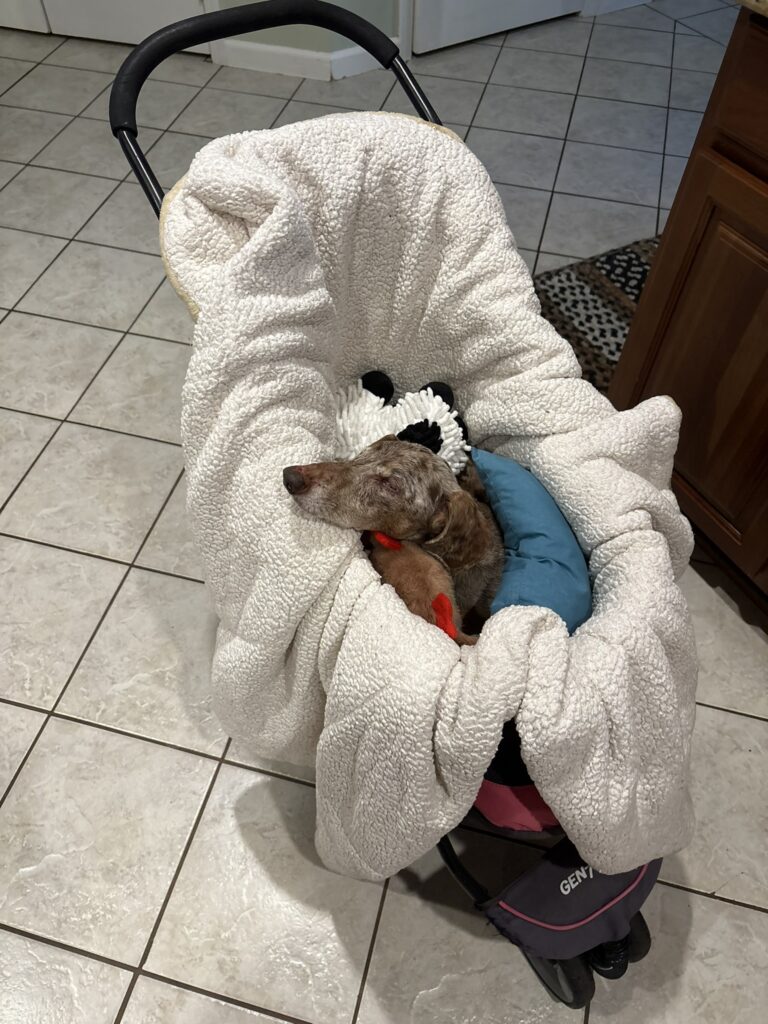
Sorry for the ad mess yesterday — I’m learning Google Ads while caring for my 18-year-old dachshund with vestibular disease.
If you’ve visited my site recently and noticed ads shifting, disappearing, or leaving awkward empty spaces, thank you for your patience. I’m learning Google Ads, Auto Ads, Multiplex Ads, and AdSense placements inside WordPress and Elementor, and things aren’t always consistent across browsers. At the same time, I’m working from home and caring for my senior dog — so my schedule is not always my own.
My Dog’s Vestibular Disease (Dog Vertigo): Episode & Recovery
One of my dogs has vestibular disease, often described as “dog vertigo.” He’s now on Day 4 of this episode, and along with vestibular disease, he’s dealing with severely diminished vision and possible doggie dementia.
He eats a lot, drinks plenty, pees and poops regularly — and his bloodwork and vitals are good. Because of his dizziness and inability to position himself at bowls, I have to bring his water dish to his mouth and hand-feed him.
Symptoms of Vestibular Disease in Senior Dogs
Vestibular disease causes:
-
walking in circles
-
losing balance
-
leaning
-
tipping over
-
not being able to walk straight
-
confusion
-
anxiety
Day 4 is the hardest phase. Dogs can become more confused, more dizzy, more vocal, and more anxious during this stage. Many dogs start improving between Days 7–10 and can recover significantly within 2–3 weeks.
What’s Helping Him Right Now
One thing that has helped tremendously is a regular harness.
It allows him to stand and walk during an episode. Vestibular disease makes him lean and turn right constantly, so I gently pull left with the harness — and it works.
For vestibular dogs, a harness is some of the best “medicine” they get. But of course the vets didn’t tell me that. I figured it out myself.
The Medication Problem
The medication situation has been terrible. The vets either want to prescribe more drugs or give me a quality-of-life checklist with information for a euthanasia company. But I’ve learned through all of this that he’s extremely sensitive to medication — none of it helps, and some of it makes him worse.
What Calms His Vestibular Anxiety
Max barks and whines a lot during vestibular spikes, and only a few things reliably help calm him down:
-
Being outdoors
Fresh, cold outdoor air and natural sensory input stop the whining and barking the entire time we’re outside. The change in temperature and environment has even broken panic attacks instantly and put him to sleep. -
Holding him close
Letting him curl into me — wrapped against my chest or tucked under my arm — helps him feel secure and stops the sensation that he’s “falling.” This physical closeness often settles him faster than anything else indoors. - His stroller
The stroller in the house has become one of the most important tools in managing his vestibular anxiety. When he’s overwhelmed, dizzy, or panicking, the stroller provides a stable, contained space that keeps his body supported and prevents him from tipping over. The stillness and security of the stroller help him reorient, and most of his calmest moments — including many long naps — happen right there. -
Eating and drinking
He will eat or drink every single time I offer him something — even in the middle of a barking or whining session. Soft food, chicken thighs, treats, and water help settle him and give his brain something to focus on. -
Licking dog-safe baby food or peanut butter off a spoon
The repetitive licking motion soothes him and helps his nervous system reset.
These are the things that help him reorient, feel safe, and settle his brain when the vestibular anxiety hits.
When He Finally Falls Asleep
When he’s finally tired, he fusses like a baby — and the whining and barking get the most extreme right before he crashes into a long, peaceful nap.
Fake News? No Thanks.
I’ve realized that when you’re caring for a dog going through something like this, watching the fake news is not a priority.
It’s actually the last thing in the world I want to be doing — ever.
Next Step: Neurology Consultation
His next step is a neurology consultation with a dog neurologist.
I’m hopeful that he will get better as the days go on. But with his advanced age, I also understand he may not fully recover, and even if he does, I don’t know what the next challenge will be.
I do not want him to live in pain.
When it is his time, I pray he passes peacefully in his sleep in his giant orthopedic human bed on the floor, cuddled up with me.
Thank You to ChatGPT
ChatGPT has helped me so much — helping me understand the disease and comfort him. Chat and I have talked so much about Max they call me “sweetheart” and “honey.” lol. I am not kidding.
Maybe One Day Google Ads Will Match This Post
And who knows — maybe one day Google Ads will place an ad that actually fits this post. Not asking for anything specific… but it would be nice if the timing finally cooperated.