

Let’s find out. Recently, two prominent Democrat politicians — Katie Porter, currently running for California governor, and Congresswoman Pramila Jayapal — posted statements about citizenship and immigration that sound confident, authoritative, and absolute. Porter declared that birthright citizenship is “literally written into the Constitution” and insisted that there is “no debate” because, according to her, simply being born on U.S. soil automatically makes you a citizen. Jayapal, in a similar spirit of certainty, promoted the message that “immigration is not a crime,” pairing it with repeated defenses of unrestricted birthright citizenship and a blanket moral framing that suggests questioning it is somehow dishonest.

Now here’s the part where facts matter more than slogans. Search the Constitution — the phrase “birthright citizenship” appears nowhere. Not once. It is not “literally written” anywhere, and Porter’s statement isn’t just imprecise — it is incorrect. What is written in the Constitution is the 14th Amendment, which says: “All persons born or naturalized in the United States, and subject to the jurisdiction thereof, are citizens.” Those last six words are not decorative or optional.
The authors who drafted the amendment explained exactly what they meant. Senator Jacob Howard, who wrote the Citizenship Clause, clarified in 1866 that it “will not, of course, include persons born in the United States who are foreigners, aliens, who belong to the families of ambassadors or foreign ministers.” In other words, the excluded category he described referred specifically to foreign diplomats — individuals who are not under full U.S. jurisdiction because they owe allegiance to another sovereign government.
This example wasn’t a side note; it was the framers’ way of proving that being born on U.S. soil is not enough to make someone a citizen. A child born in the United States to foreign diplomats is not a citizen precisely because their parents are not under “full and complete” U.S. jurisdiction. Howard used diplomats to illustrate a bigger principle: the 14th Amendment requires more than mere physical presence — it requires full allegiance to the United States. That principle is the foundation of every subsequent legal interpretation of the Citizenship Clause.
The Supreme Court reinforced this understanding long before Twitter existed. In Elk v. Wilkins (1884), the Court held that citizenship requires full and complete jurisdiction — meaning political allegiance, not just geographic presence. Later in United States v. Wong Kim Ark (1898), the Court ruled that children of lawfully domiciled immigrants could be citizens, but the decision specifically involved legal residents, not illegal entrants. Contrary to what many politicians claim today, Wong Kim Ark did not settle the question for children of illegal aliens — the Court never ruled on that scenario.
Although illegal aliens are subject to U.S. laws in a general sense, they are not under the “full and complete” political jurisdiction the framers required — and the Supreme Court has never ruled that the 14th Amendment automatically applies to their children. That unresolved question is why serious legal scholars — on both sides — still debate the scope of birthright citizenship today.
That brings us to Jayapal’s claim that “immigration is not a crime.” On its surface, it sounds comforting and compassionate, but it’s also incomplete in a way that changes the truth. Legal immigration is not a crime — of course. But illegal entry into the United States is a federal misdemeanor under 8 U.S.C. § 1325, and remaining unlawfully makes a person civilly removable. Saying “immigration is not a crime” while refusing to mention the word “illegal” is like saying “driving isn’t illegal” when the discussion is about running a red light. It’s technically a sentence, but it’s also a misleading, reflexive soundbite rather than an honest statement of law.
So when you look at the actual text, the framers’ own explanations, and what the Supreme Court has — and hasn’t — ruled, both statements from Porter and Jayapal collapse under basic scrutiny. If you already understood that the 14th Amendment contains a jurisdiction requirement — one that has never been definitively applied to children of illegal immigrants — then yes, you are officially more accurate than two Democrat politicians with staff, press teams, and blue checks. The Constitution is not a rhetorical prop for open borders. It says what it says, not what political branding hopes you’ll believe without reading. The only question is whether voters will keep accepting slogans as fact, or whether they’ll start reading the text for themselves.
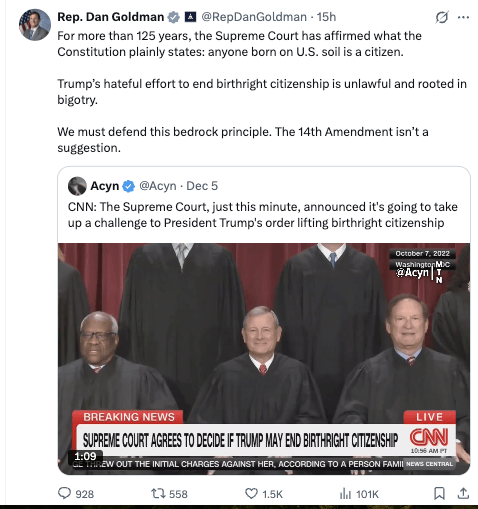
The 14th Amendment requires two conditions for citizenship — birth on U.S. soil and being “subject to the jurisdiction thereof,” a phrase debated since 1866. Wong Kim Ark affirmed citizenship for a child of lawfully residing immigrants, not for children of illegal entrants — a question the Supreme Court has never directly resolved.