
Never-Trumper and Biden voter Michael Steele used his turn filling in for Jen Psaki on the July 30, 2026, edition of The Briefing to accuse Elon Musk of fighting for the ability to digitally undress people without their consent.
He then immediately tied that accusation to Musk’s political spending, portraying him as the same person planning to pour more than $100 million into an effort to help Republicans win in November.
The segment’s framing was clear: ridicule Musk, portray him as toxic, and suggest that Republicans are desperate for help from a polarizing figure.
During the segment, Steele told viewers:
“Minnesota’s state legislature passed a law banning AI tools that let users generate sexually explicit images of people without their consent. Now Musk and his company is fighting that law.”
He added:
“That’s the kind of thing Elon Musk is focused on right now—overturning laws that stop his AI robots from undressing you on the internet.”
That framing makes it sound as though xAI filed a lawsuit demanding the right to create nonconsensual fake pornography.
But Steele left out the most important part of the story.
Minnesota’s Law Is Not Limited to Nonconsensual Images
Minnesota’s new law is commonly described as a ban on AI tools that create sexually explicit images without consent. But Steele failed to explain that the law itself is not limited to nonconsensual images.
The law is written so expansively that it could also restrict consensual, private, and constitutionally protected AI image editing—including when an adult consented to the image’s creation or created the image of himself or herself.
xAI argues that the law could apply when:
- An adult knowingly agrees to have an image altered.
- Someone edits a photograph of himself or herself.
- An image is created privately and never distributed.
- An image is artistic, satirical, educational, political, medical, scientific, or religious.
- A technology company prohibits abusive conduct and installs safeguards, but a user manages to evade those protections.
xAI also points out that even when a company bans the behavior and tries to stop it, the company could still face enormous penalties if a user finds a way around its rules.
Minnesota’s law subjects technology providers to potential civil penalties of up to $500,000 for each unlawful access, download, or use.
xAI Supports Banning Nonconsensual Fake Nudes
Steele also failed to tell viewers that xAI’s complaint expressly acknowledges Minnesota’s interest in stopping nonconsensual sexually explicit deepfakes.
Its argument is that Minnesota drafted an overly expansive law that goes far beyond targeting malicious, nonconsensual images.
The law places liability on the owners and operators of websites, applications, software, and other technology services. xAI argues that providers could face crushing penalties even when they prohibit the conduct and make good-faith efforts to prevent it.
In its complaint, xAI notes that the law “imposes an overbroad, content-based ban on free speech and the tools of visual expression in a clumsy attempt to prohibit ‘nudification.’”
The company further contends that the statute lacks important exceptions and could punish technology providers over consensual, private, or constitutionally protected images.
Steele ignored those arguments.
He told viewers that Musk was planning to spend $100 million to help Republicans during the midterm elections. He brought up Musk’s support for Donald Trump in 2024 and his involvement in the Wisconsin Supreme Court race.
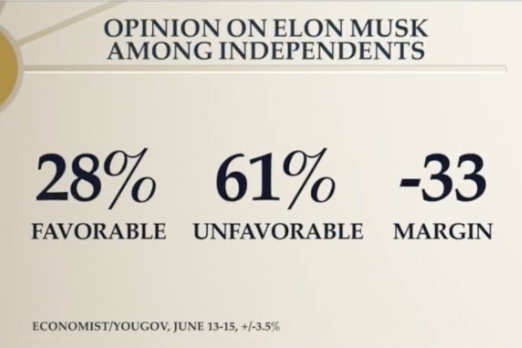
Steele cited an Economist/YouGov poll from YouGov, a British polling firm based in London, showing that 61% of independent voters viewed Musk unfavorably, compared with 28% who viewed him favorably—a 33-point net unfavorable margin.
Then Steele brought on Democratic strategist Chuck Rocha, highly partisan Democrat and former Obama official Norm Eisen, and establishment Axios reporter Alex Isenstadt — who broke the story about Musk’s midterm spending and has long focused on covering Republican politics and President Trump — to agree with him.
No guest was present to explain or defend xAI’s actual legal arguments.
Viewers deserved both sides and the facts.
Michael Steele gave them Democratic and establishment propaganda.
Watch on Rumble