
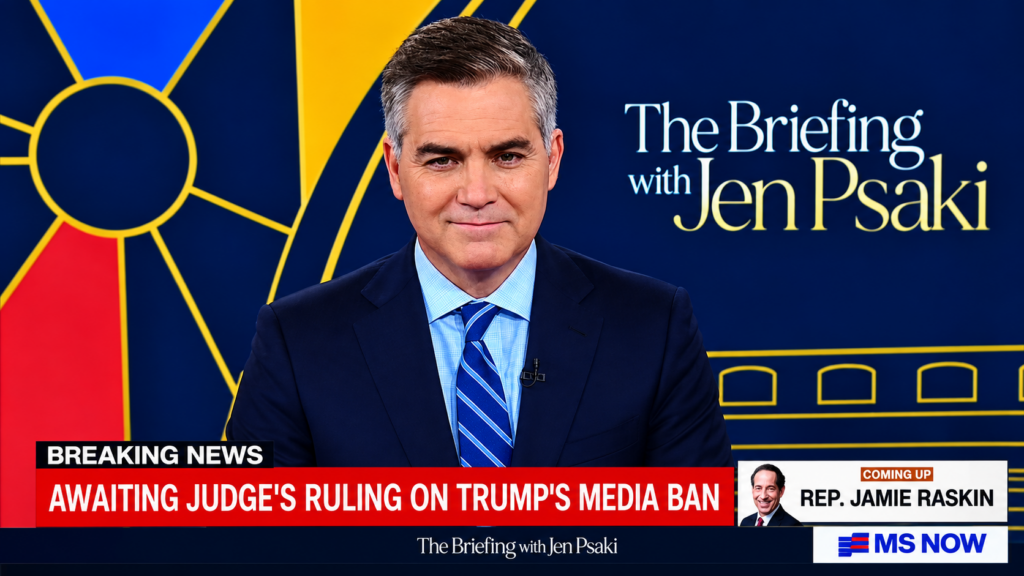
On the September 23, 2026 edition of The Briefing with Jen Psaki on MS NOW, Psaki spent the first part of her show arguing that Trump was “lashing out” over his poll numbers. She also dismissed the administration’s national-security justification, saying the “national security excuse doesn’t really hold much water either.” Then she brought on former CNN White House correspondent Jim Acosta, who echoed her argument and took it even further.
Psaki asked what stood out to him from the court hearing. Acosta did not start with the filings, the letters, or the arguments. He started with a diagnosis:
“Well, this case is not about national security. It’s about Donald Trump’s insecurities. And there are a lot of them. He is trying to ban the press because he doesn’t like what he calls fake news and negative news.”
The administration publicly stated its reasons. In letters filed with the court, the White House accused the outlets of failing standards of professionalism and decorum, including by “trafficking in verifiable falsehoods about national security and other issues, and publishing sensitive or classified information.” It pointed to specific reporting about U.S. munitions supplies during the Iran war, Iran negotiations, and security-related details involving White House construction. But Acosta jumps straight to Trump’s “insecurities.”
The same news organizations accused of publishing that information are the ones covering the story. They’re not going to honestly report on themselves. And the networks standing in solidarity with CNN aren’t going to honestly report on the allegations against CNN either.
Meanwhile, Acosta tells viewers what Trump is thinking, what Trump is trying to accomplish, and how unnamed executives in Washington and New York might react. That is not reporting what was established in the record. It is Acosta’s interpretation of Trump’s motives.
Acosta kept going:
“He is trying to, I think, soften up the coverage as we head into this midterm cycle. He knows that going after certain organizations will send a chill down the spines of certain media executives, I guess, in this town and up in New York, and that they may respond accordingly by telling their journalists, ‘Hey, we can’t go so tough on this guy.’
To me, this is the time. If there isn’t a time, um, for intense coverage on Donald Trump, it’s just never going to happen. The time is now.”
“I think.” “I guess.” Then a made-up quote from made-up executives.
Why is the job to be “tough” on Trump? The job of a newsroom is to report what happened, check the facts, question those in power and let the audience decide — not start from a position of hostility and then worry that the coverage might not be “tough” enough.
By Acosta’s own wording, he assumes the press is already being tough on Trump. His concern is that pressure from the White House might cause journalists to become less tough in their coverage.
When was the last time you heard a prominent television journalist openly worry that reporters weren’t being “tough enough” on a Democratic president?
Never.
News coverage of Trump goes beyond tough and intense. It is overwhelmingly negative and often framed through the most hostile possible interpretation. The major networks went after Trump relentlessly during his first term, continued the negative coverage after he left office, and picked it right back up when he returned to the White House.
Just watch the coverage. But the studies back up the extraordinary level of negativity, too. Harvard’s Shorenstein Center said Trump’s first 100 days of his first term “set a new standard for unfavorable press coverage of a president.” Its study found that not a single major topic produced coverage that was, on balance, more positive than negative.
Among news reports with a clear tone, the study found that coverage across the mainstream media outlets analyzed was 80% negative and 20% positive.
Since then, it’s only gotten worse.
Then Acosta said:
“He has tried to stop mail-in balloting in this country. He is now attempting a press ban in this country. Who knows if he’s going to honor the election results coming up? All of this warrants very tough coverage.”
Trump has publicly called for ending mail-in voting. But the March 31 executive order did not abolish mail-in voting nationwide. It sought to tighten mail-in and absentee-ballot procedures, including citizenship-verification measures and USPS requirements for official election-mail envelopes with unique barcodes.
Jim said: “Who knows if he’s going to honor the election results coming up?”
Who knows if Democrats are going to get caught cheating in the election again, while the fake news ignores it like they always do, Jim.
He also said he hoped Judge Timothy Kelly would issue a “full-throated defense of the First Amendment,” and that a ruling limited to Fifth Amendment due process would only mean Trump was “going to try this again.”
Psaki then turned to President Xi’s arrival, noting that a red carpet had been rolled out for the leader of a country with what she called a “horrific record on press freedom.” But in the very next breath, she pointed out that the networks were not showing the event — and said she was “encouraged” by their decision.
Psaki was criticizing Xi’s record on press freedom while praising American news organizations for choosing not to provide viewers the usual pooled television coverage of a presidential event. Other news organizations were still able to cover the event, but the five major television networks chose not to provide their usual pooled video coverage after the White House prevented CNN from fulfilling its scheduled pool assignment. ABC, CBS, NBC and Fox declined to replace CNN, and the network television pool suspended its coverage in solidarity.
Acosta also said news organizations should have banded together earlier over the “Gulf of America” dispute, and he described the ABC and CBS settlements as “extortion payments.”
Instead of reporting the news, the goal becomes targeting Trump with intense and very tough coverage, encouraging news organizations to band together, while Democratic talking points get repeated and Trump’s accomplishments are minimized, ignored, or buried.
They needed the story to be about Trump’s feelings, because feelings do not have to be sourced.
Whatever happened to reporting the news?
UPDATE: Hours after this segment aired, Judge Timothy Kelly granted CNN, MS NOW and Politico temporary relief, ordering the White House to restore their access after finding that the outlets were likely to succeed on their Fifth Amendment procedural-due-process claim. Acosta had called for a “full-throated defense of the First Amendment,” warning that if the judge ruled only on due process, Trump was “going to try this again.”
That is exactly where the judge landed — for now. No “full-throated” First Amendment ruling for Acosta.
Watch on YouTube